Bullet time is the shot everyone wants from an AI video model: the world stops, a splash hangs in mid air, and the camera keeps moving round it. Ask for it the lazy way and the splash melts, the face drifts and the light swings halfway round the arc. Water beads slide sideways. The back of the head, which the model never saw, turns to wax.
This post is the short version of my Prompt Bible, Catalog No. 368, The Frozen Moment. The fix comes down to one idea: hold the moment, move the camera. Here is why bullet time fails in AI video, and the prompts I use to make it hold.
What is bullet time, and where did it come from?
The idea is older than cinema tricks. In 1878 and 1879 Eadweard Muybridge used lines of cameras to capture a moment from different positions, and the Wikipedia page on Muybridge shows how far that work went. Tim Macmillan began his Time-Slice work in 1980, using a circular arrangement of pinhole cameras. The Matrix made the look famous in 1999, when John Gaeta and Manex Visual Effects arranged cameras on a track behind a green screen, as the Wikipedia article on bullet time describes.
The trick was always the same: the subject stays still while the viewpoint moves. Real rigs get that for free because every camera sees the same frozen instant. A video model has to fake it.
Why does bullet time fail in AI video?
A video model has no rig of cameras. It invents every frame, so each frame is a chance for the scene to change its mind. The same five failures show up again and again:
- The subject keeps drifting, even though you asked for a freeze.
- Water beads slide sideways instead of hanging.
- The back of the head melts as soon as the camera goes round, because the model never saw it.
- The light swings with the lens, so the sun seems to travel with the camera.
- The background changes mid-arc.
Every one of these is the model filling a gap you left open. The fix is to close the gaps in the prompt.
What are the 8 rules of a frozen moment?
- One readable peak. Pick the single instant everyone understands, such as the top of a splash.
- Something hangs. Give the eye droplets, dust or fabric to prove time has stopped.
- Nothing in the scene moves. The world is a sculpture.
- Only the camera travels, in one smooth arc, at one distance and one height.
- The subject stays centred, with honest parallax between near and far.
- Solid from every side. Describe the back and sides so there is nothing to melt.
- The light stays fixed in the world, not on the lens.
- Make the opening view and the far view as stills first, then animate between them.
Say these in plain words. "Bullet time" on its own invites the model to improvise, and rule 8 is the one that changes results most. It is the same habit I use for heat haze: lock the look in stills, then let the video model only do the travelling.
How do you build the start and end frames for bullet time?
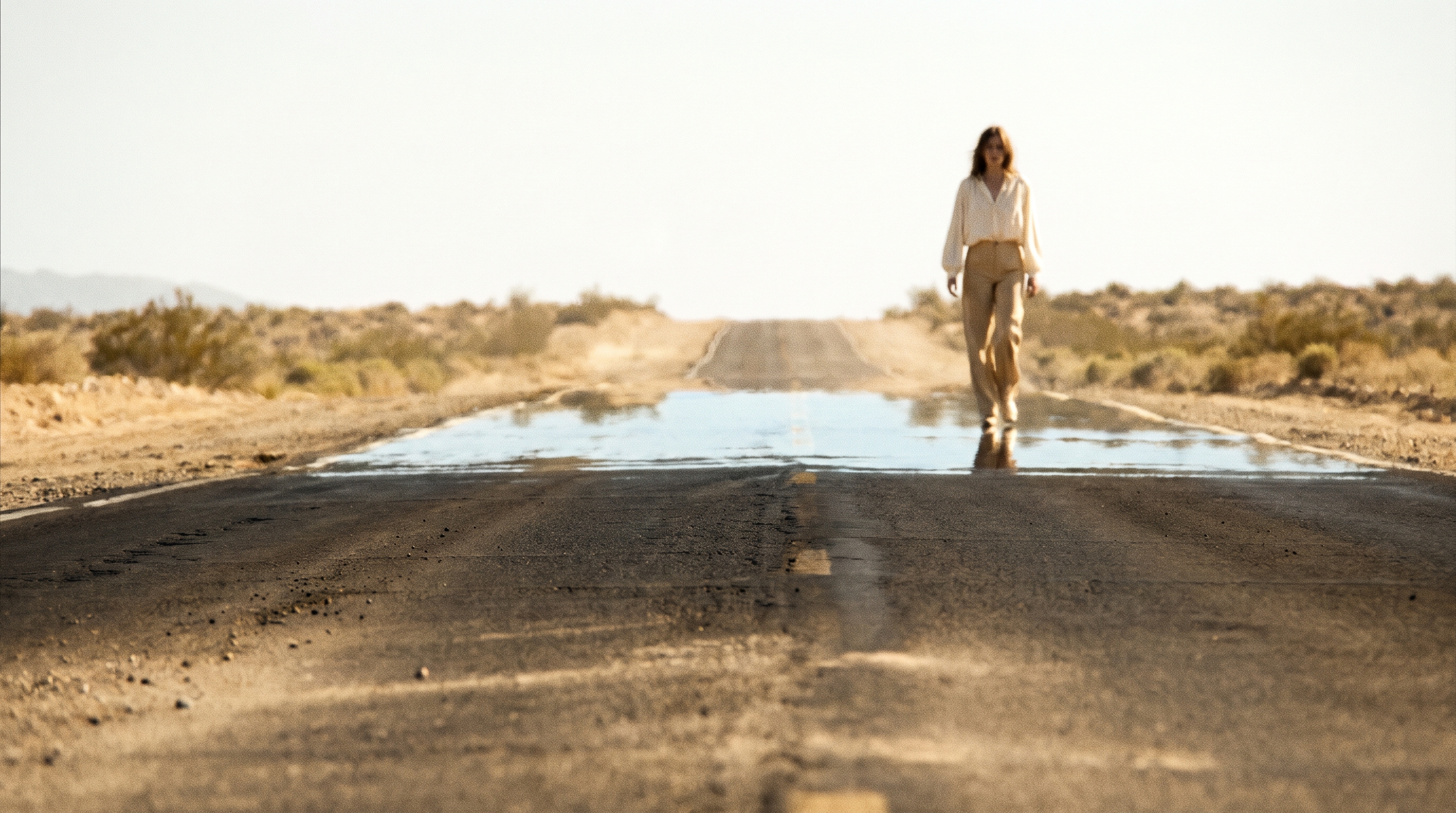
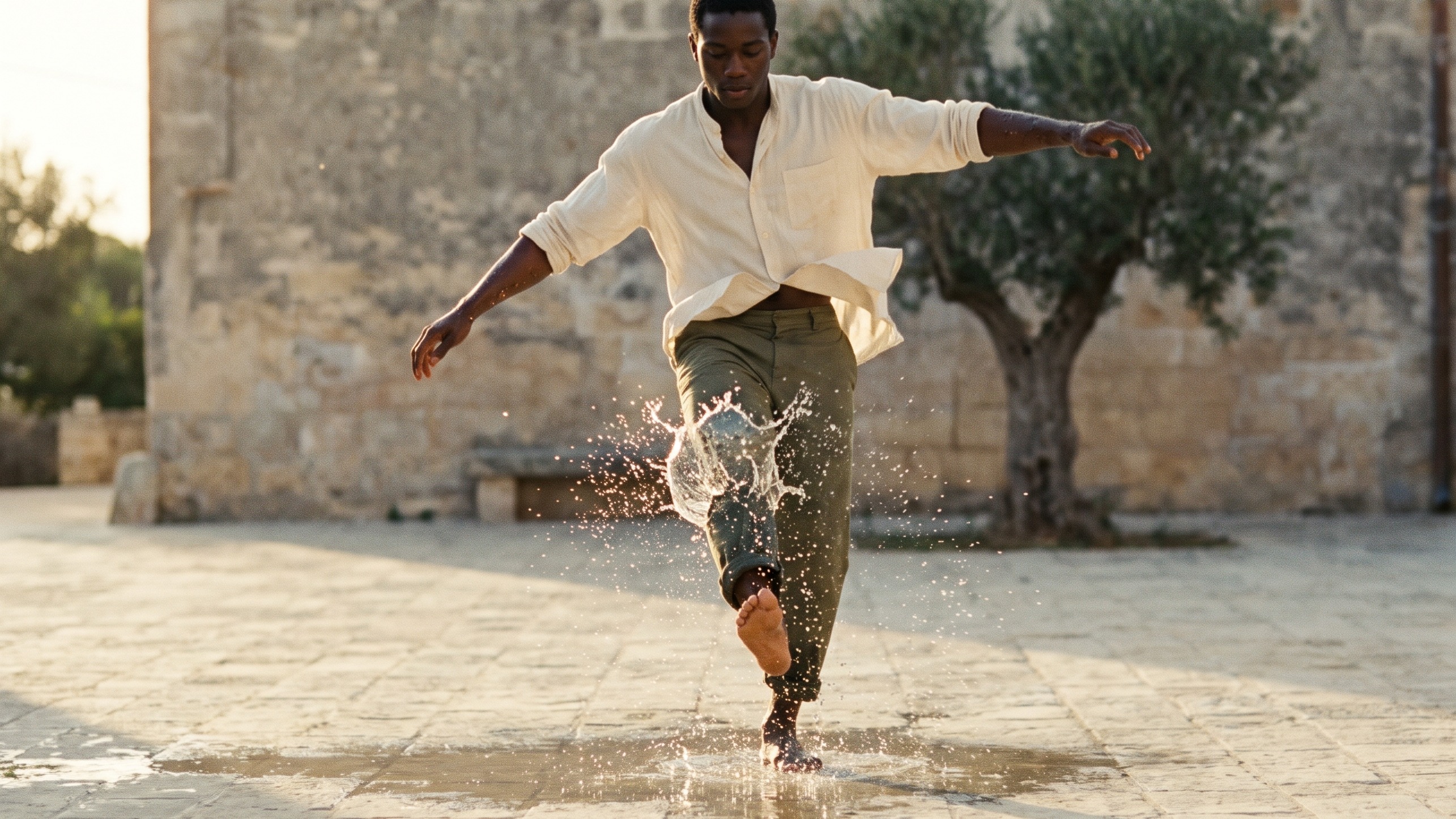
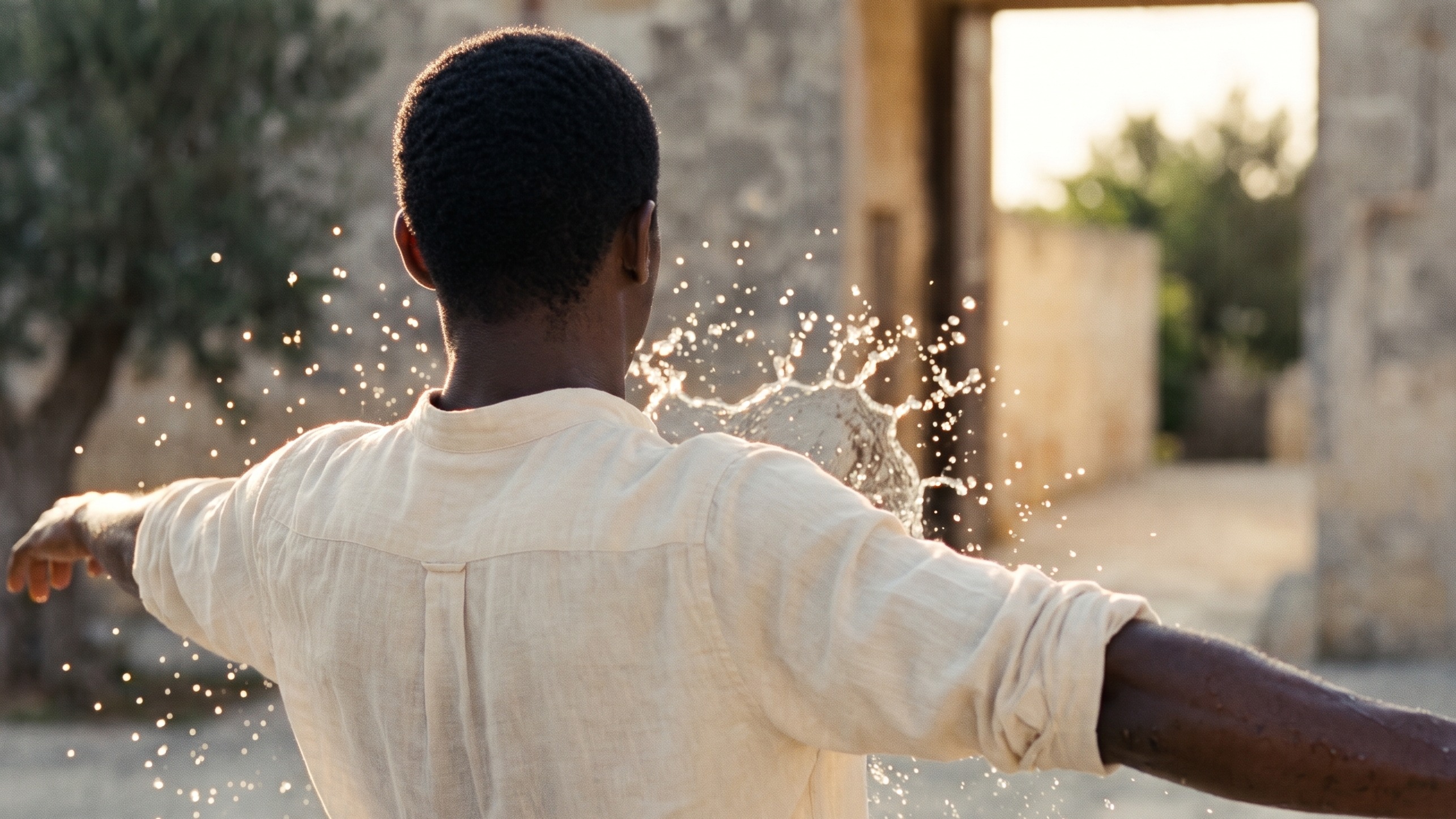
The cover image at the top of this post is the opening view. The picture above is the far view, made by giving the image model the first picture as a reference and asking for the same scene seen from the other side of the arc. Because both stills share one world, the video model only has to travel between two images it can already see. It stops inventing, and the splash holds.
Here is the stills prompt pattern. Swap the subject for your own invented person.
Prompt · Nano Banana Pro
A single frozen instant at the peak of a splash: a young woman mid-laugh in a shallow fountain, water crown and individual droplets hanging in the air, every droplet sharp and round. Camera at eye level, 35mm, two metres from her, centred. Soft overcast daylight from high camera left, fixed in the world. Solid, fully described clothing and hair from every side. No text, no logos.
Prompt · Nano Banana Pro
Using the first image as the reference, the same frozen instant seen from the opposite side of the arc, 180 degrees round. Same person, same droplets in the same positions, same fountain, same overcast light from the same fixed direction in the world, so the shadows now fall differently. Same eye level and distance, centred. The back of her head and clothing fully solid and consistent. No text, no logos.
How do you prompt the camera arc in the video model?
Feed both stills in as the first and last frame, then keep the video prompt short and strict. Say what must not move, say the camera path once, and say the light stays put. I wrote about how lens choice shapes space in focal length as narrative, and the arc should always be motivated camera movement with a reason behind it. If a move still feels weightless, give it foreground anchors to measure depth against.
Prompt · Seedance, Kling or Veo
Time is frozen. Nothing in the scene moves: every droplet, strand of hair and ripple stays exactly where it is. Only the camera moves, in one smooth, slow orbit of 180 degrees around the subject at a constant distance and constant eye-level height, from the first frame to the last frame. The subject stays centred. Near droplets shift against the far background with honest parallax. The light stays fixed in the world, so shadows turn naturally as the camera passes. No cuts, no zoom, no text. Avoid: cuts, zooms, drifting droplets, a melting back of the head, shifting background, light that follows the lens.
What should you check before you hit generate?
Run this short list on every attempt:
- Is there one clear peak, and does something visibly hang?
- Does the prompt say nothing moves except the camera?
- Is the arc one direction, one distance, one height?
- Are the back and sides of the subject described?
- Does the light stay fixed in the world?
- Do the start and end stills agree about every droplet and shadow?
If the back of the head melts, rewrite the far still, not the video prompt. If the light swings, state the light direction in world terms, such as the side of the fountain the sun is on.
Hold the moment, move the camera
Next time a frozen shot comes back melting, check your prompt for the one readable peak, the thing that hangs, the still world, the single smooth arc, the sides you described and the light that stays put. Write those six things, make both stills first, and the model usually stops improvising and starts travelling.
All the people in these examples are invented, with no logos and no writing.
Questions
What is bullet time?
Bullet time is a shot where the action appears frozen while the camera moves around it. It grew from early multi camera studies by Eadweard Muybridge and became famous through The Matrix in 1999.
Why does bullet time fail in AI video?
A video model invents every frame, so the subject drifts, water beads slide sideways, the back of the head melts, the light swings with the lens and the background changes mid arc unless the prompt closes each of those gaps.
How do I keep the subject from moving in an AI bullet time shot?
Say that time is frozen and that nothing in the scene moves except the camera. Pick one readable peak, give the scene something that hangs in the air, and name every droplet or strand that must stay exactly where it is.
Why make the start and end frames as stills first?
Two matching stills give the video model a first and last frame it can already see, so it only has to travel between them instead of inventing the far side of the subject.
How does Jo Aiba prompt a smooth camera arc?
Jo Aiba writes one orbit at a constant distance and eye level height, keeps the subject centred with honest parallax, states that the light stays fixed in the world and bans cuts and zooms.