I keep coming back to a problem that haunts so many generative shots: the camera moves, but nothing feels like it occupies actual physical space. The lens glides smoothly enough, yet the scene stretches like rubber instead of showing true parallax depth. It is the classic floating camera phenomenon.
What strikes me is how often we blame the motion diffusion model when the issue is actually in the composition of our starting image. When a model receives a flat composition where everything sits on a single middle distance plane, it lacks the geometric reference points needed to calculate spatial depth during motion generation.
Why do AI camera moves often feel ungrounded?
When a cinematographer tracks through a room, the audience senses physical presence because objects close to the lens pass by faster than objects far away. In AI video generation, the model relies on sharp contrast boundaries and overlapping layers to simulate this spatial separation. If your base image lacks clear foreground elements, the diffusion model treats the frame as a single flat surface, stretching pixels rather than generating convincing perspective shifts.
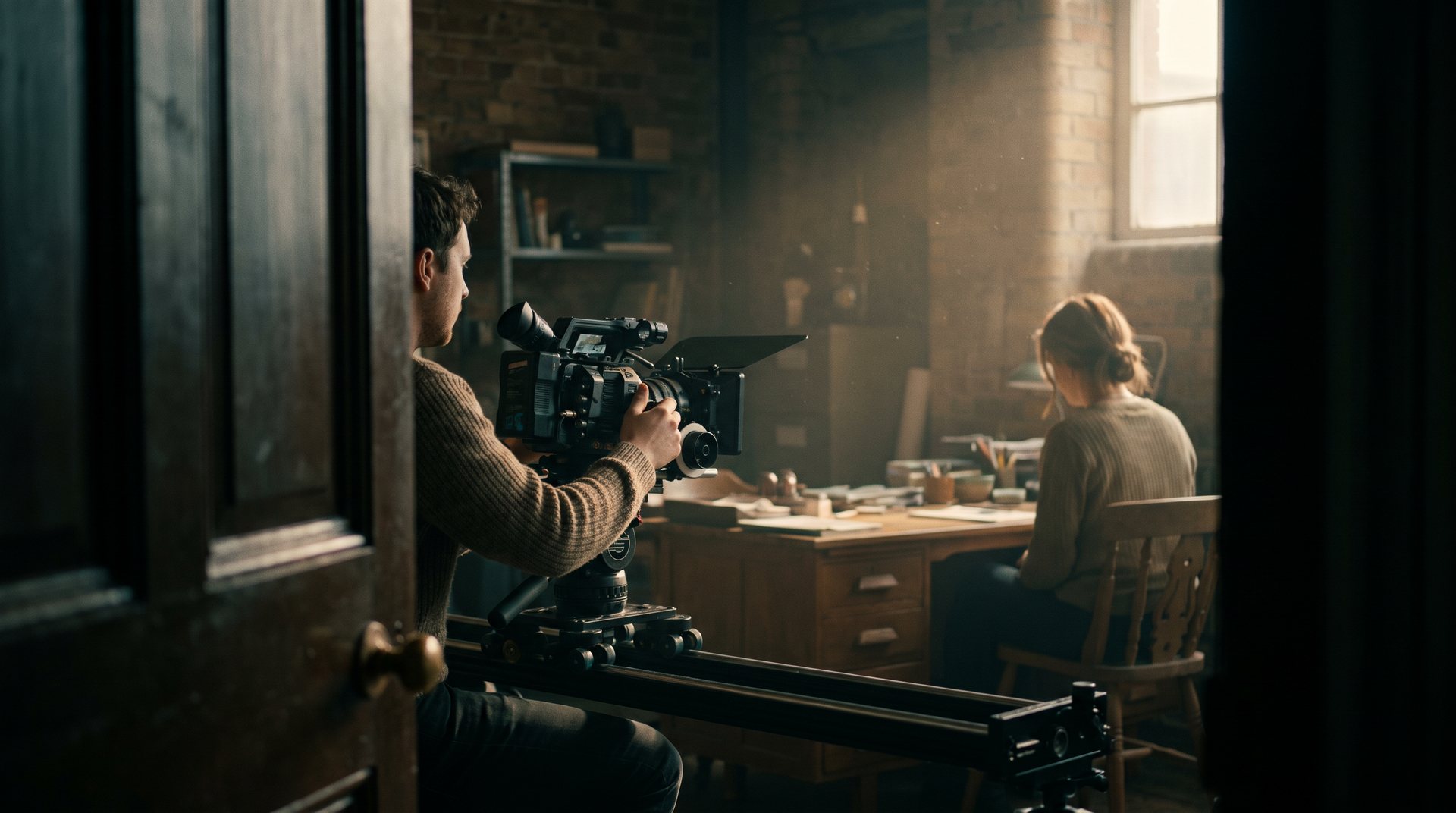
By deliberately placing framing elements in the extreme foreground, out-of-focus doorframes, hanging foliage, or the dark silhouetted shoulder of a character, you give the generator an unyielding physical anchor. As the camera panned or pushed forward, the model uses that foreground obstacle to lock down the realistic speed of the background movement.
How do you build foreground anchors that hold their shape?
The key lies in the initial image prompt. You want to explicitly define three distinct depth planes: extreme foreground framing, midground subject, and deep background ambient light. Make sure the foreground element is partially obscuring the view.
Here is a prompt structure for Midjourney or Flux to generate a grounded anchor frame for an interior sequence:
Prompt · Midjourney or Flux
Cinematic shot framed through a dark doorframe, extreme close foreground shadow framing the left edge, a woman sitting at a sunlit wooden desk in the midground, soft atmospheric haze, deep shadows in the background studio, shot on 35mm lens, f/2.8 depth of field --ar 16:9
When you pass this initial image into a video diffusion model like Luma, Kling, or Runway, prompt for a slow horizontal track rather than a rapid push forward.
Prompt · Luma, Kling or Runway
Slow horizontal pan left across the room, foreground doorframe passes by sharply creating deep parallax depth, stable midground subject, cinematic lighting
For exterior scenes, natural textures like wet leaves or architectural pillars work brilliantly to anchor complex camera paths.
Prompt
Wide low angle cinematic shot, out-of-focus wet tree branches framing the top right foreground, an abandoned stone church sitting on a misty hill in the distance, dramatic overcast light, subtle volumetric fog --ar 16:9
Then, when generating video from this base frame, describe the motion of the lens specifically in relation to that foreground detail.
Prompt
Slow camera track forward past the wet foliage in the foreground, revealing the stone church, subtle fog movement, grounded physical camera tracking
Notice how these prompts describe relative position rather than abstract camera buzzwords. You are giving the video model a clear spatial relationship to solve. The result is camera movement that feels anchored in real physical geometry.
Ideas are like fish. If you want to catch little fish, you can stay in the shallow water. But if you want to catch the big fish, you've got to go deeper.
David Lynch
Questions
Why do AI camera moves feel floaty?
They feel floaty because the starting image is often a flat composition with everything on one middle distance plane. The model then has no geometric reference points to calculate depth, so it stretches pixels instead of producing true parallax.
What is a foreground anchor in AI video?
A foreground anchor is a framing element placed in the extreme foreground of your base image, such as an out-of-focus doorframe, hanging foliage or a dark silhouetted shoulder. It gives the generator a physical obstacle to use when working out how fast the background should move.
Which depth planes should I put in my image prompt?
Define three distinct planes: extreme foreground framing, a midground subject and deep background ambient light. Make sure the foreground element partially obscures the view.
What camera move works best with Luma, Kling or Runway?
A slow horizontal track works better than a rapid push forward. The article's example asks for a slow horizontal pan left with the foreground doorframe passing by sharply, which creates deep parallax depth while the midground subject stays stable.
What can I use as foreground anchors in exterior scenes?
Natural textures like wet leaves or architectural pillars work well for anchoring complex camera paths. In the article's example, out-of-focus wet tree branches frame the foreground while a stone church sits on a misty hill in the distance.